Board
3D Renders
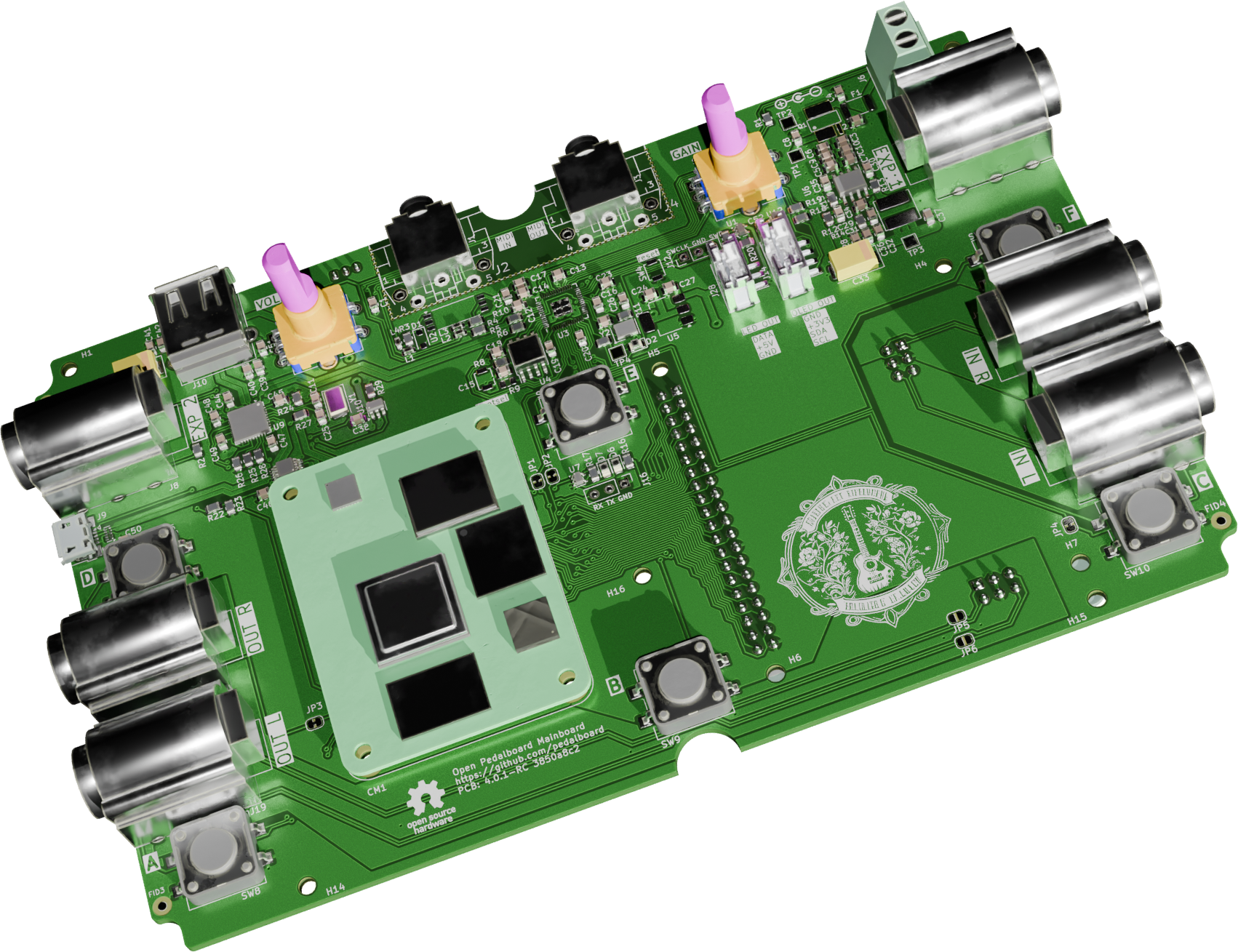
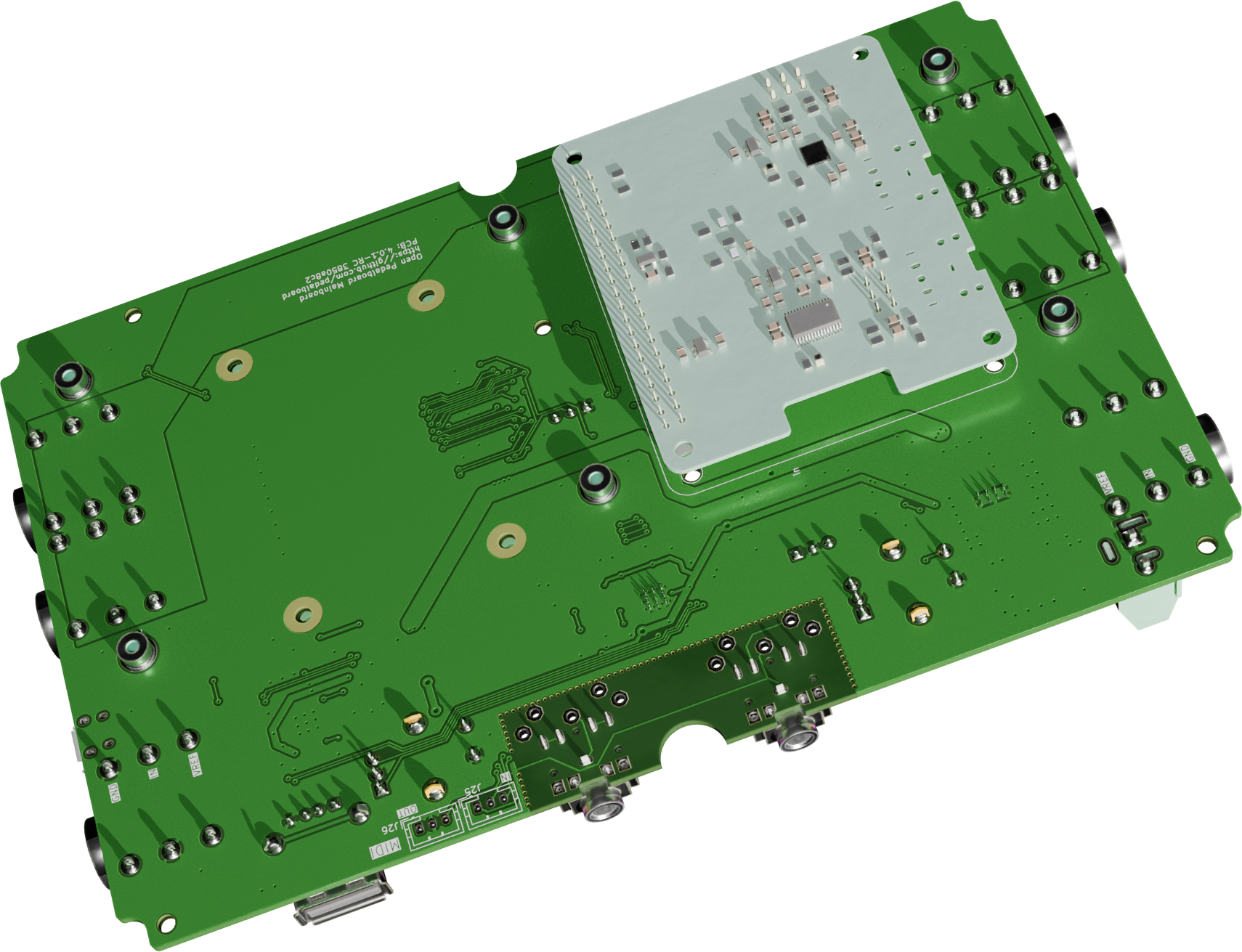
Schematic & PCB
Interactive BOM
Audio Processing
- Raspberry Pi Compute Module 4 or Compute Module 5
- Flexible memory options for cost optimisation
- Optional WiFi
- Very low latency (~2ms with ELK Audio OS)
- Pedalboard Soundcard — two channel differential I/O
- or HiFiBerry DAC+ ADC PRO — high quality stereo I/O
- USB-A host + Mini USB device mode (firmware update)
MIDI and Control Surface
- Raspberry RP-2040 with custom firmware (USB or WLAN update)
- 6 foot buttons (push, release, long/short press)
- 2 rotary encoders with push button
- 2 expression pedal inputs
- 8 RGB LED rings around each foot button
- 2 RGB status LEDs
- STEMMA I2C connector for 2 OLED displays
- I2C EEPROM for config storage
- Flexible MIDI I/O: DIN 5, 3.5mm TRS, header pins, USB MIDI
Power Supply
- 6–28V DC input (standard pedalboard PSU) with 3A buck converter
- USB powered option for MIDI module
- ORing support between onboard PSU and USB power
Design Decisions
- USB 2.0 only — 480 Mbps is more than sufficient for audio (stereo 24-bit/192kHz ≈ 9 Mbps) and MIDI. USB 3.0 would add cost, routing complexity, and require a 4-layer PCB — with no practical benefit for this use case.
- 2-layer PCB — keeps manufacturing cost low and the project accessible to makers. USB 2.0 signal integrity is manageable on 2 layers with careful routing and short trace lengths.
- Dual-processor architecture — the RP2040 handles MIDI control with instant startup, while the CM4/CM5 runs ELK Audio OS for audio processing. This separation ensures the control surface is always responsive, independent of the audio OS boot state.
- Modular design — the board works as a standalone MIDI controller without a CM4 installed, or as a full audio processing platform with CM4/CM5 + soundcard. Common components and existing modules (HiFiBerry, CM4) keep the BOM accessible.